

As one of the UK’s fastest-growing sports, Padel is beginning to make a real impact on the commercial property market.
At Nimbus, we’ve been watching this growth closely. Padel is changing how property owners, developers, and operators use space, from converting warehouses into outdoor leisure areas to reusing empty retail sites.
Now, we’re taking that analysis a step further.
We’re delighted to announce that Nimbus has joined forces with The Padel Directory to bring deeper, data-led insight into the UK padel market. Together, we’ve launched Padel Pulse - a new initiative designed to track planning activity, monitor approval trends, map demand growth and highlight untapped opportunity across the country.
This partnership provides developers, agents, landowners, and investors with the market clarity they crave.
Why padel? Why now?
In the last three years, padel has gone from a new curiosity to a sport with real momentum. More people are playing, new operators are growing fast, and well-known leisure brands are joining in. For the property sector, planning applications for padel facilities are increasing quickly.
As we discussed in our earlier blog about padel’s growing popularity and its effect on the UK property market, the sport is appealing because it’s easy to access, social, and commercially strong. Courts are in high demand, players spend more on extras, and sites can be flexible, making padel attractive to both operators and landlords.
But with this fast growth comes important questions. Where is demand really rising? Which councils are approving new sites, and which are holding back? Is there a risk of too many sites in some areas? Most importantly, where are the remaining real opportunities?
Answering those questions requires more than anecdote. It requires data.
Who are The Padel Directory?

The Padel Directory, powered by Vitality, is the UK’s leading platform dedicated entirely to the sport of padel. It connects players with clubs and courts nationwide, promotes new venues, supports operators and acts as a central hub for the UK padel community.
Operators gain visibility and credibility. Players can easily find and explore new places to play. For the wider industry, it provides a real-time view of where the sport is expanding.
The Padel Directory has unique insight into new venues, operator growth plans, and local demand. By combining this knowledge with Nimbus’s property, planning, and location data, we can offer a clearer picture of the market.
Introducing Padel Pulse
Padel Pulse is a new, ongoing insight series analysing the real estate footprint of padel across the UK. Its purpose is straightforward: to bring structure and transparency to a fast-moving sector.
With Padel Pulse, we’re tracking padel planning applications across the UK, analysing approval rates and identifying the areas with the most development. We’re also seeing which councils are most supportive, where challenges are emerging, and how these trends align with local populations and leisure areas. Our main aim is to help developers and operators make smarter choices about where to grow.
Our first set of data already tells an interesting story.
What the first round of data tells us
According to our initial Padel Pulse analysis, we identified 891 padel planning applications across the UK during 2025.
That number alone confirms the scale of activity. Padel is a material contributor to planning pipelines nationwide.
However, the true insight lies in the Padel Pulse launch report - 385 applications have already been granted, while 317 remain pending. A further 59 have been refused and 51 withdrawn, with smaller numbers categorised as unknown, not required, split decision, decision closed or amendment.
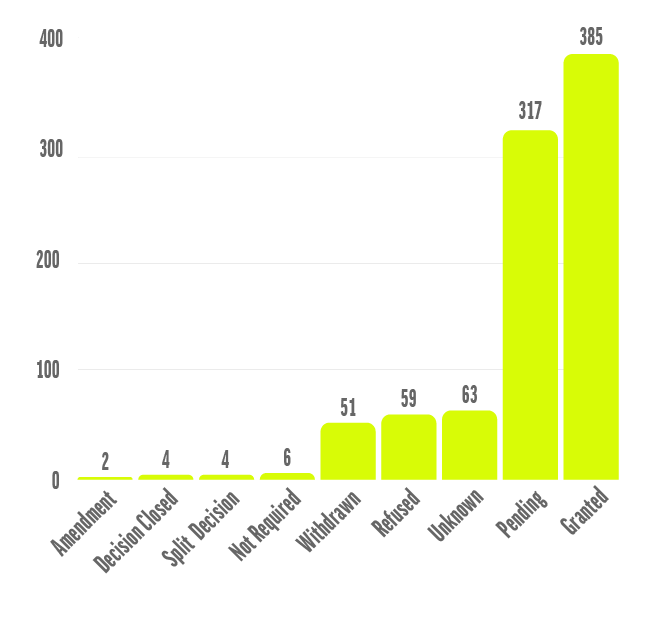
Chart showing the 891 padel planning applications identified across the UK in 2025, broken down by status.
So, what does this mean?
First, approval volumes are significant. With hundreds of applications granted, councils are broadly supportive of padel schemes when proposals are appropriately located and well-designed. Second, the pipeline remains substantial. The 317 pending applications suggest continued growth through 2026 and beyond. Third, while refusals are present, they are not dominant - indicating that planning success is achievable with the right strategy.
For developers, this highlights a key point: Padel is a real opportunity, but careful planning is crucial.
Where is activity concentrated?
The Top 20 council broken down in the Padel Pulse report highlights where application volumes are currently most concentrated.
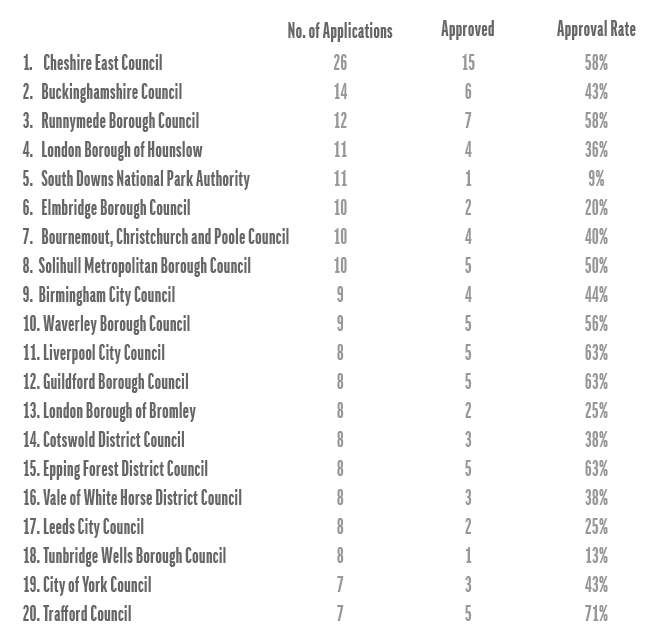
Top 20 UK councils by number of applications submitted - showing how many were approved and at what rate.
Cheshire East Council leads with 26 applications, 15 of which have been approved, delivering a 58% approval rate. Buckinghamshire Council follows with 14 applications and a 43% approval rate. Runnymede Borough Council has seen 12 applications with a strong 58% approval rate, while the London Borough of Hounslow and the South Downs National Park Authority have each recorded 11 applications - though with very different outcomes.
For example, the South Downs National Park Authority has approved only one of 11 applications, which is just a 9% approval rate. This significant difference shows how environmental rules and planning considerations can significantly affect whether a project goes ahead.
Some councils have much higher approval rates. Trafford Council, for example, has a 71% approval rate. Liverpool City Council, Guildford Borough Council, and Epping Forest District Council each have an approval rate of 63%. For operators looking to expand, knowing how different councils act is very useful.
It’s not just about where people want padel. It’s also about where planning rules allow it.
What influences planning success?
Our analysis suggests several recurring factors influence planning outcomes.
Site context is paramount. Schemes located within established leisure parks, edge-of-town retail environments, or existing sports facilities tend to perform better than proposals in protected landscapes or highly sensitive residential settings. The low approval rate in national park jurisdictions reinforces this point.
Noise is getting more attention. Because padel can be loud, councils look closely at how close courts are to homes, what steps are taken to reduce noise, and how courts are set up. Applications that deal with noise issues - like using enclosures, screens, and good management - are more likely to be approved.
Lighting and opening hours matter too. Proposals for floodlights, especially for late-night play, can lead to objections. Careful lighting plans and setting curfews can make a big difference.
Finally, projects that turn empty retail warehouses or unused industrial spaces into padel courts often fit well with local regeneration goals, which can help their planning case.
How Nimbus supports padel developers
While more people playing padel gives operators confidence, successful growth depends on carefully selecting the right sites.
Nimbus helps developers find the right types of sites, like empty big-box stores, underused leisure parks, extra car parks, and brownfield land. With detailed planning and land-use data, users can filter sites by size, nearby homes, access, parking, and closeness to other amenities.
Nimbus also helps with demographic and catchment analysis. Tools like drive-time modelling, population profiles, and income data help operators determine whether a location can support enough members and additional spending. Mapping competitors also lowers risk by showing where other padel sites are already located or planned.
Importantly, Nimbus also allows developers to track live planning applications. Monitoring pending padel submissions helps identify both emerging hotspots and potential saturation points. Combined with historical approval data, this creates a powerful framework for risk assessment.
In short, Nimbus turns padel expansion from guesswork into a data-driven strategy.
Untapped opportunity
Even though 891 applications in one year show the scale, activity isn’t spread evenly. Some wealthy commuter areas and leisure towns are seeing significant growth, but many parts of the UK still have few padel courts. Mid-sized towns with strong residential development pipelines, growing commuter populations and limited racket sports infrastructure present compelling opportunities. Locations with surplus retail stock or flexible warehouse space may offer particularly attractive entry points.
In future Padel Pulse updates, we’ll continue mapping these untapped areas and exploring where expansion could make sense next.
The bigger property story
Padel’s rise is clearly part of a larger move toward experience-focused leisure and the reuse of spaces in new ways. As retail evolves and landlords seek ways to attract people, padel brings activity, longer visits, and community involvement. of planning permissions already granted and hundreds more pending. The sport is establishing a tangible and expanding real estate footprint.
Through our partnership with The Padel Directory, Nimbus is committed to tracking this growth and helping the market respond in smart ways.
Padel Pulse is only the start. Watch out for our next update.
If you’re exploring site acquisition, refining your expansion strategy or assessing planning risk, the Nimbus team is here to help. We can show you how spatial data, catchment modelling and live planning intelligence combine to support smarter, more scalable growth decisions — giving you clarity before you commit.